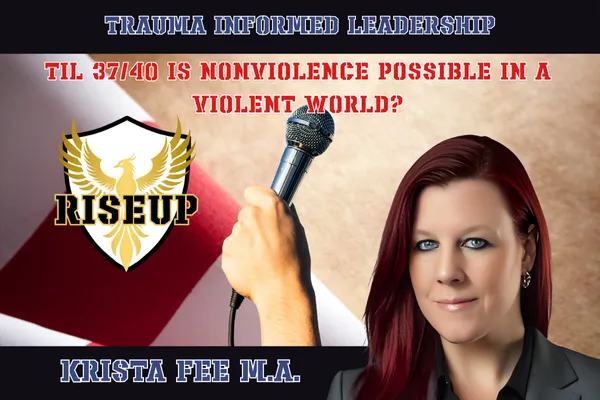
Is NonViolence Possible In a Violent World:
Is Nonviolence Possible in a Violent World?
The Tension Every Trauma-Informed Leader Must Face
By Krista Fee – Founder of the RISEUP Phoenix Trauma and Crisis Institute
As a practitioner, educator, and survivor, my work has always circled around one central paradox: how do we live, lead, and protect in a world that is undeniably violent while still holding fast to the hope of peace? In this blog, adapted from my RISEUP Voices from the Frontlines podcast series on Trauma-Informed Leadership, I explore the deep question of whether nonviolence is possible in our modern world, and what that means for leaders at every level.
The Old Question: Violence, Peace, and the Burden of Leadership
Human history is written in conflict. Empires have risen and fallen on battlefields, revolutions have been ignited through bloodshed, and every generation has faced the haunting question: Is peace possible without violence?
Plato wrestled with justice in The Republic, trying to reconcile philosophy with order. Augustine birthed “just war theory” in a world torn apart by Rome’s collapse. Gandhi argued that love could break oppression without ever lifting a sword, only to be cut down by an assassin’s bullet. Winston Churchill stood defiant against fascism, insisting appeasement was suicide.
These leaders lived in different times, but they all lived in tension with the same reality: nonviolence is beautiful in vision, but terrifying in practice.
Gandhi: The High Cost of Ahimsa
Mohandas Gandhi embodied the principle of ahimsa—non-harm. His Salt March of 1930 inspired millions not with weapons, but with the moral power of peaceful resistance. Images of Indian men and women beaten without raising a hand shocked the world and exposed the brutality of colonial power. And yet, the cost was devastating. Thousands jailed. Communities brutalized. Independence itself arrived drenched in blood. Gandhi’s nonviolence proved transformational but also fragile, unable to prevent violence unleashed from within.
The lesson: nonviolence can shake empires, but it does not shield against pain.
Martin Luther King Jr.: Love as a Weapon
Dr. King brought Gandhi’s lessons to the American South. He reframed nonviolence as “soul force” — a weapon of love that could expose injustice and convert enemies into allies.
When children in Birmingham were blasted with fire hoses, the world saw not disorder but moral courage. King knew the risks. He endured bombings, jailings, and threats. His final speech in Memphis carried the gravity of a man who knew the bullet was coming: “I may not get there with you, but we, as a people, will get to the promised land.”
His life reminds us: nonviolence can win battles and shift laws, but it demands leaders willing to give everything.
Churchill: When Violence Cannot Be Avoided
In 1938, many British leaders hoped appeasement would keep Hitler at bay. Churchill saw differently: fascism was not negotiable. His words — “You were given the choice between war and dishonor. You chose dishonor, and you will have war” — still rings with clarity.
When bombs rained down during the Blitz, Churchill’s voice steadied a nation. His leadership testified to a sobering truth: there are moments when nonviolence is not just a matter of survival; it's a surrender of all you stand for, and that may be unacceptable.
Mandela: Holding Both Resistance and Reconciliation
Nelson Mandela began as a disciple of nonviolence, but eventually co-founded a militant resistance wing against apartheid. For this, he spent 27 years in prison. The miracle was not only his release; it was his choice to return to reconciliation rather than to vengeance. The Truth and Reconciliation Commission, though imperfect, embodied a different kind of legacy: repair.
Mandela teaches us that sometimes resistance requires force, but healing requires forgiveness. The leader’s task is not to glorify one side but to hold both truths.
A Trauma-Informed Dilemma
For trauma-informed leaders, this question is deeply personal. Survivors know that love cannot always change an abuser, that some boundaries must be enforced, and that protection sometimes demands resistance.
But they also know violence escalates cycles of harm. To answer violence only with violence risks perpetuating the very trauma we are called to disrupt.
This is the razor’s edge: leaders must prepare for resistance without glorifying it, protect without dehumanizing, and pursue peace while acknowledging that survival sometimes demands force.
My Personal Questions
Now I understand many of you don't go into the dark places my team and I do, and you may be thinking, "There's nothing in my scope of leadership that could come down to life-or-death decisions...that is not the world we live in. What will you do if an active shooter enters your building, or a myriad of other potential challenges this world may bring to your doorstep? If you have not prepared, you have already made your choice. " When I step into leadership, I ask myself two questions that ground me:
What cause am I willing to die for?
What cause am I willing to take life for?
They are not comfortable questions. But if I don’t ask them, someone else may decide for me. These questions frame the weight of leadership. They remind me that leadership is not about slogans or ease, it's a deep awareness of the inherent responsibility leaders carry for human lives.
The Peaceful Warrior
The image I hold is the “peaceful warrior.” A leader who does not seek war, but who does not stand naïve to danger. A leader who sees violence as the last option, never the first.
The peaceful warrior is disciplined enough to hold steady, compassionate enough to honor dignity, and courageous enough to protect without losing humanity. Gandhi’s fasts, King’s marches, Churchill’s speeches, Mandela’s reconciliations—all different, all paradoxical, but all committed to dignity.
Practical Takeaways for Leaders
Anchor in Values – Decide in advance what you are willing to sacrifice for and where your boundaries lie.
Prepare Without Glorifying – Train for crisis, but don’t let conflict become your identity.
Separate Behavior from Identity – Hold people accountable for harm without collapsing their humanity.
Model Dignity Under Pressure – Even when forced to resist, do so without cruelty.
Commit to Repair – When harm occurs, return to reconciliation as soon as safety allows.
Closing Thoughts
Perhaps the question is not whether nonviolence is always possible, but whether we as leaders will carry dignity into whatever reality we face. Peace must always be our aspiration. Resistance may sometimes be our reality. And dignity must remain our compass.
As Dr. King once warned: “It is no longer a choice between violence and nonviolence in this world; it’s nonviolence or nonexistence.”
The challenge of trauma-informed leadership is not to find easy answers, but to carry paradox with courage.
Call to Action
If this conversation stirred something in you, I invite you to go deeper.
📅 Book a call with me to explore how trauma-informed leadership training could transform your organization: https://calendly.com/riseupphoenix/compass
🔥 Join the Trauma-Informed Leadership Course and Community — a space for leaders to gain IACET CEUs, tools, and a practical framework for embedding trauma-informed leadership into every part of life and work. (Link coming soon.)
Together, we can rise out of the ashes of violence and lead with fire that heals, not harms.


