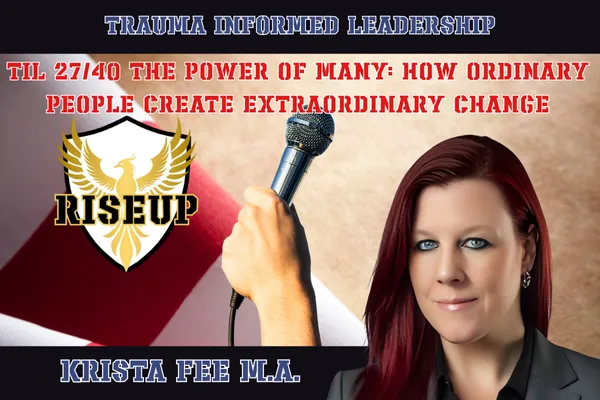
The Power of Many: How Ordinary People Create Extraordinary Change
The Power of Many: How Ordinary People Create Extraordinary Change
Why resilience and healing emerge most powerfully in community
By Krista Fee
Founder, RISEUP Phoenix Trauma and Crisis Institute
As a trauma-informed practitioner and leadership trainer, my work is dedicated to redefining leadership so it heals rather than harms. For years, I have walked alongside survivors, first responders, and communities in crisis. One lesson I’ve learned again and again is this: transformation rarely belongs to the lone hero. It is sustained by the Power of Many...ordinary people who choose to act together.
Beyond the Lone Actor
The Power of One matters. One act of courage can disrupt silence, ignite momentum, or save a life. But sparks by themselves are fragile. They flare up, but without fuel and without others to carry them, they fade.
Movements, systems, and communities endure not because of lone heroes but because ordinary people take responsibility together. This is the Power of Many, the shift from I to WE.
And if trauma isolates, convincing people they are alone in their suffering, then healing and resilience are born most powerfully in connection and community.
The Science of Collective Action
Psychology tells us humans are wired for belonging. Social identity theory explains that we draw courage and meaning from our groups. Alone, courage feels costly. Together, courage feels possible.
Albert Bandura’s research on collective efficacy reinforces this truth: groups that believe in their shared ability to act accomplish far more than individuals, no matter how skilled. One firefighter may feel powerless against a wildfire, but when they see crews, engines, and air support working in sync, hope and capacity multiply.
Trauma research echoes the same principle. Trauma narrows and isolates. Collective experience expands. Vigils, marches, and rituals regulate the nervous system, restore voice, and remind people they are not alone. One voice can be dismissed. A chorus cannot.
Stories from History: The Many at Work
History is filled with examples of the Power of Many:
The Abolitionist Movement – Harriet Tubman and Frederick Douglass were vital, but they were not alone. Families who opened homes along the Underground Railroad and preachers who risked pulpits made the movement possible.
The Suffrage Movement – Names like Susan B. Anthony endure, but women’s right to vote was secured through the collective sacrifice of thousands, marchers, hunger strikers, and voices like Ida B. Wells, who refused to be silenced.
The Civil Rights Era – Dr. King was not a lone actor. Ella Baker, Fannie Lou Hamer, SNCC students, and countless unnamed marchers and organizers carried the weight of a movement.
Solidarity in Poland – Lech Wałęsa is remembered, but it was the sight of entire shipyards standing together that shook the regime.
These stories remind us: leadership matures when it multiplies.
Crisis on the Frontlines
I’ve seen the Power of Many in action through Battle2be’s RISEUP Rapid Response Team. Alone, a rescuer in floodwaters can only cover so much ground. But a community organized into pods can search entire neighborhoods and bring the lost home.
When children are rescued from trafficking, it’s never a lone hero. It takes investigators, shelters, advocates, law enforcement, and communities who open their doors. One act opens the way, but many are needed to bring a child fully home.
After 9/11, the Power of Many was visible in every street, neighbors checking on neighbors, strangers holding candles together, firefighters digging side by side through rubble. The grief was immense, but so was the unity.
This is what the Power of Many looks like in crisis: despair broken by solidarity.
The Fragility of Over-Reliance on One
The myth of the lone hero is dangerous. When organizations or movements rest on one figure, they collapse if that person falters or betrays trust. History is littered with revolutions that unraveled, nonprofits that imploded after a founder stepped down, and communities traumatized when leaders abandoned them.
Trauma-informed leadership resists this. Over-reliance is unsafe, for the leader and for the people. Real resilience requires multiplication.
Tactical Strategies for Multiplying Power
Here are trauma-informed practices leaders can use to cultivate the Power of Many:
Equip Through Mentorship – Share skills, processes, and wisdom to empower emerging leaders.
Distribute Responsibility – Avoid bottlenecks by decentralizing authority across pods, committees, or teams.
Create Rituals of Belonging – Shared meals, songs, commemorations, or even gratitude rounds build “we.”
Listen Laterally – Build peer-to-peer networks, invite dissent, and resist dependence on a single voice.
Protect Integrity – Revisit the mission often, guarding values fiercely to prevent drift or co-optation.
Healing Through Collective Leadership
Trauma tells people their voices don’t matter. Collective leadership heals by restoring agency, voice, and responsibility. I’ve seen survivors of violence become leaders in advocacy groups, first responders find renewal in peer-led teams, and communities devastated by disaster rise again because the weight was shared.
As the African proverb says: “If you want to go fast, go alone. If you want to go far, go together.”
Closing: From Spark to Chorus
The Power of One still matters—it breaks the silence and sparks change. But lasting transformation requires the Power of Many. It is not the lone hero who saves the ocean. It is the many, walking the shoreline side by side, each lifting starfish, each proving that ordinary people, acting together, can create extraordinary change.
And as always, I’ll leave you with this reminder:
I may only be able to save one starfish at a time, but together we can save them all. I may be just a single drop in the ocean, but together we become a tidal wave of change.
Practical Takeaways
Sparks inspire, but movements endure when ordinary people act together.
Trauma isolates; community restores voice and resilience.
Collective action multiplies courage, capacity, and healing.
Strong leaders cultivate the Power of Many through mentorship, distribution, rituals, and protection of values.
Call to Action
📅Book a call with Krista to explore how the Power of Many can transform your leadership or organization.
🔥 Join the Trauma-Informed Leadership Course & Community (link coming soon) to access tools, CEUs, and a network of leaders dedicated to healing and resilience.


