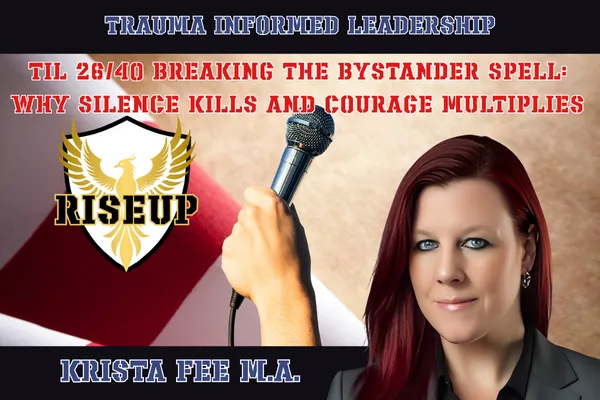
Breaking the Bystander Spell: Why Silence Kills and Courage Multiplies
Breaking the Bystander Spell: Why Silence Kills and Courage Multiplies
How trauma-informed leadership transforms silence into courage
By Krista Fee
Founder, RISEUP Phoenix Trauma and Crisis Institute
As a trauma-informed practitioner and leadership trainer, my purpose is to help leaders carry responsibility with clarity, integrity, and courage. Every episode in this series grows from my personal mission: to transform how we think about leadership so it heals rather than harms. Today’s focus is on a subject we all encounter: silence in the face of crisis, and why breaking that silence is one of the most powerful acts of leadership.
The Starfish and the Spell
You may have heard the starfish story, but let me tell it the way I share it in my work.
A little girl with ringlet curls and ruffled petticoats walks along a beach after a storm. The sand is covered with thousands of starfish, stranded in the sun. She bends down, picks one up, and gently tosses it back into the sea.
An old man watching her laughs. “Why bother? There are too many. You’ll never make a difference.”
The girl looks down at the starfish in her hand, tosses it back into the waves, and says softly, “It made a difference to this one.”
Here’s the lesson: most people walk past the starfish. They see. They care. But they assume someone else will act. That paralysis is what psychology calls the bystander effect, and it kills courage before it can begin.
The Science of the Bystander Effect
In 1968, psychologists Bibb Latané and John Darley found that the more people are present, the less likely anyone is to take action. Responsibility diffuses, fear takes hold, and silence reigns.
Think about it: how many times have we seen headlines about assaults on busy streets with dozens of witnesses who did nothing? Or workplace harassment ignored by entire departments? Silence feels safe in the moment, but for the person in crisis, it can be a life-or-death betrayal.
Trauma and the Spell of Silence
For those with trauma histories, silence cuts even deeper. Survivors of abuse or abandonment know the wound of calling out for help and hearing nothing. When leaders or peers remain quiet, that old wound is reenacted.
Trauma-informed leadership refuses neutrality. Even if you don’t have the perfect words, presence matters. Saying, “I see this. I will not look away. I will stand with you,” disrupts the cycle of abandonment.
Stories of Silence That Cost Lives
History shows us the price of silence:
Rwanda, 1994: International debate over language: “acts of genocide” vs. “genocide”, cost 800,000 lives.
The Challenger Disaster, 1986: Engineers warned of faulty O-rings, but their voices were drowned out by bureaucracy. Silence killed seven astronauts.
Workplace Harassment: Entire organizations stayed quiet, allowing abuse to thrive until survivors broke the silence through #MeToo.
Waiting is never neutral. Waiting costs lives, trust, and hope.
Stories of Courage That Multiply
If silence multiplies harm, courage multiplies healing.
The White Helmets in Syria ran toward the rubble when bombs fell, pulling survivors to safety.
#MeToo voices shattered years of secrecy and created a global movement.
Flight 93 passengers on 9/11 acted with courage that prevented unimaginable destruction in Washington, D.C.
Courage is contagious. One person stepping forward gives others permission to do the same.
The Trauma-Informed Cost of Silence
Silence isn’t just the absence of action; it’s reenactment. The nervous system of a survivor reads silence as a sign of danger. That’s why leaders must speak, even if imperfectly. Neutrality is not an option when lives, dignity, or justice are at stake. To choose not to act IS to choose harm.
A Framework for Breaking the Bystander Spell
Leaders can break the silence through intentional action:
Name the Silence – call out hesitation directly.
Take the First Step – small acts signal that courage is possible.
Anchor in Integrity, Not Outcome – focus on doing what’s right, not what’s guaranteed to succeed.
Use the Witness Principle – remember your action models courage for others.
Build Cultures of Permission – ensure people know they can speak without retaliation.
Train for Action – just as fire drills prepare for a crisis, practice speaking up in small moments.
Hold Accountability – leaders must be responsible for harm caused by silence.
Closing: From Spell to Spark
Silence may feel safe, but it kills. Courage may feel costly, but it multiplies. Trauma-informed leadership teaches us that breaking the silence isn't just about heroism; it's the first step towards healing.
Be the one who speaks. Be the one who acts. Because courage, once modeled, spreads faster than fear.
As I often remind my audiences:
I may only be able to save one starfish at a time, but together we can save them all. I may be just a single drop in the ocean, but together we become a tidal wave of change.
Practical Takeaways
Silence reenacts trauma. Presence disrupts it.
Aligned Courage doesn't guarantee an outcome; it does guarantee integrity.
Breaking the silence gives permission for others to act.
Systems must train, model, and reward intervention.
Call to Action
If this message resonates, let’s connect.
📅Book a call with Krista to see how trauma-informed leadership training can transform your organization.
🔥 Join the Trauma-Informed Leadership Course & Community (link coming soon) to gain practical tools, CEU-certified training, and a network of leaders committed to rising together.


