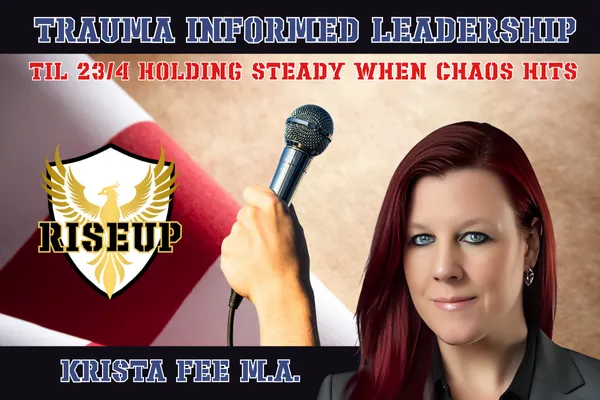
Holding Steady When Chaos Hits
Holding Steady When Chaos Hits
Why trauma-informed leaders must anchor themselves and others when storms inevitably come
By Krista Fee, M.A.
As a trauma-informed practitioner, founder of the RISEUP Phoenix Trauma and Crisis Institute, and someone who has walked through both personal and community-level crises, I’ve learned this: leadership is never tested in calm waters. It is in chaos, floods, scandals, pandemics, and betrayals that the true fiber of leadership is revealed. My purpose in writing this series is to equip leaders of every kind: government officials, nonprofit directors, educators, CEOs, parents, and partners, with tools to lead not from panic but from presence.
In Episode 23 of RISEUP Voices From the Frontlines: The Trauma-Informed Leadership Series, we stepped directly into the storm with one question: how do leaders hold steady when chaos hits?
The Storm Always Comes
Chaos is not optional. Sooner or later, every leader faces it. Sometimes it is external, like a natural disaster, a global pandemic, or an organizational scandal. Sometimes it is deeply personal, like the death of a loved one, betrayal within your inner circle, or the collapse of a critical relationship.
In these moments, followers do not need you to be inhumanly perfect. They seek connection and presence.
Winston Churchill once said during World War II: “It is not enough that we do our best; sometimes we must do what is required.” What is often required of leaders in chaos is not brilliance or bravado, but the quiet discipline of holding steady.
Neuroscience: Why Steadiness Matters
Trauma and crisis destabilize the nervous system. Under stress, people drop into survival states: fight, flight, freeze, or fawn. In those moments, the leader’s nervous system becomes the thermostat for the group.
Polyvagal theory explains this phenomenon: people “borrow regulation” from others. If a leader remains calm and grounded, others begin to settle. If a leader panics, panic multiplies.
Research on emotional contagion supports this. Leaders’ moods ripple through teams, shaping morale, decision-making, and even performance. Calm breeds calm. Panic breeds chaos.
I’ve seen this play out in crisis response again and again: whether in rushing floodwaters or the tense hours of a child recovery operation. Families watch responders not just for action, but for steadiness. Their nervous systems are looking for cues: “Is hope possible? Can we trust this moment?”
Story: Floodwaters and Faces of Fear
I will never forget a flood response in which families sobbed on riverbanks, waiting for news. The water was dark, fast, and full of debris. Every instinct screamed danger. And yet the responders, trained and trauma-informed, held steady.
One team member said afterward, “The families weren’t watching our hands. They were watching our faces. They needed to see if we believed rescue was possible.”
That’s leadership in chaos. The steadiness of one nervous system became the anchor for many.
Transparency in the Fog
One of the greatest mistakes leaders make in chaos is choosing silence, believing it will avoid panic. But silence breeds rumors, and rumors often become more destructive than the truth. What we leave to imagination, we leave to exaggeration. Our minds often create far worse scenarios than reality ever could.
The antidote is transparency. Not pretending to know everything, but communicating honestly: “Here’s what we know. Here’s what we don’t know. Here’s what we’re doing next.”
John F. Kennedy modeled this during the Cuban Missile Crisis. He did not posture with false certainty. Instead, he consistently communicated risks, facts, and options. His steadiness and transparency, without bravado, helped prevent nuclear escalation.
The same is true in smaller but equally high-stakes scenarios: when bringing a trafficked child home, I’ve learned never to overpromise. Telling a family “everything will be fine” erodes trust. Saying “this is what we know, this is what happens next” creates fragile but vital threads of trust that can hold.
Consistency Over Charisma
Charisma may inspire briefly, but when the storm lingers, people look for something sturdier: consistency.
Angela Merkel, Germany’s chancellor through the Eurozone debt crisis and the refugee influx, was not known for fiery speeches. Yet her quiet, measured consistency gave her nation and the EU a sense of reliability. She was called the “steady hand of Europe.”
Consistency does not mean rigidity. It means showing up predictably in tone, values, and follow-through, even as strategies adapt. The lighthouse doesn’t change its principles with every wave. It remains constant, signaling trust even as waters shift.
Story: Unity After 9/11
The days following September 11, 2001, are etched into memory. The nation was shaken, grieving, and afraid. What mattered most in those hours was not eloquent speeches but consistent presence.
First responders digging through rubble became beacons. Covered in ash, exhausted beyond measure, they modeled steadiness by simply showing up day after day. That consistency, quiet, unglamorous, unrelenting, anchored an entire nation in unity.
Unity in tragedy is never built on words alone. It is built on leaders who refuse to abandon their post when chaos surges.
The Temptation to Abandon the Post
Chaos tempts leaders in two destructive directions:
Withdrawal. Overwhelm silences some leaders. But silence is experienced as abandonment.
Overreaction. Others grasp for control, lash out, or make impulsive promises. But overreaction compounds chaos.
Both are trauma responses. Both are understandable. And both dim the light.
Great leadership resists both. It stays visible, steady, and grounded even when outcomes remain uncertain.
Practices of Trauma-Informed Steadiness
Holding steady does not mean being superhuman. It means building practices that keep you anchored.
Grounding rituals (breathwork, prayer, embodied pauses).
Support systems (mentors, peers, accountability partners).
Boundaries (acknowledge fear without absorbing every burden).
Repair practices (own mistakes quickly, restore trust visibly).
These disciplines don’t erase fear. They make steadiness possible in the midst of it.
Practical Takeaways
Anchor yourself before you anchor others.
Choose transparency over silence.
Prioritize consistency over charisma.
Resist the twin temptations of withdrawal and overreaction.
Practice rituals that restore your nervous system so you can restore others.
Conclusion
The storm always comes. And when it does, people won’t remember the perfection of your plan. They will remember whether you stayed steady. The lighthouse does not calm the seas. It does not prevent the storm. But by refusing to abandon its post, it saves lives.
That is trauma-informed leadership in chaos.
Call to Action
➡️Book a call with me through Calendly to explore how Trauma-Informed Leadership can transform your leadership and your organization.
➡️ Join the Trauma-Informed Leadership Course and Community (link coming soon) for CEUs, tools, and a supportive network of leaders committed to leading with steadiness and compassion.


