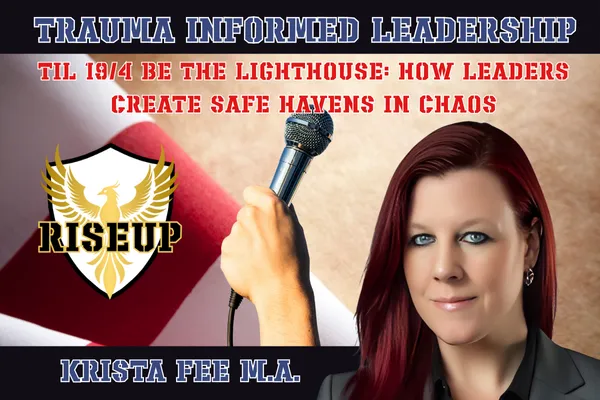
Be The Lighthouse: How Leaders Create Safe Havens in Chaos
Be the Lighthouse: How Leaders Create Safe Havens in Chaos
Why trauma-informed leadership requires steady beams, not storms of control
By Krista Fee – Founder of RISEUP Phoenix Trauma and Crisis Institute
Every storm tests a system. It might be a fire department after a line-of-duty death, a hospital staff weathering burnout, or a family learning to survive betrayal. In these moments, people don’t need perfection. They need steadiness.
I’m Krista Fee, founder of the RISEUP Phoenix Trauma and Crisis Institute, and my purpose in writing this series is to show leaders what it means to become a lighthouse in storms; leaders who shine steadily when everything else is chaos. As someone who grew up in unsafe systems, surviving trafficking-related abuse, childhood sexual violence, and domestic violence, I know firsthand how vital safe havens are. They are not luxuries. They are lifelines.
In this blog, we’ll explore why safe havens matter, how language and predictability create them, and how trauma-informed leadership can help organizations and communities withstand pressure.
The Science of Safety
Safety is not sentimentality. It’s biology.
When human beings are unsure of what to expect, their nervous systems shift into a state of vigilance. Cortisol spikes, adrenaline floods, creativity plummets, and memory erodes. Chronic uncertainty literally reshapes the brain, trapping individuals in a state of perpetual survival mode.
But predictable routines, honorable boundaries, and calm tones tell the vagus nerve: You are safe enough to engage. This is the physiological infrastructure for collaboration and performance.
I’ve witnessed this firsthand on the frontlines. When the command staff establishes steady routines, responders can quickly reset and regulate. When leaders bark unpredictably, shame their teams, or shift rules midstream, mistakes multiply. Steadiness becomes science in action.
Psychological Safety: Risk Without Retaliation
Harvard researcher Amy Edmondson defines psychological safety as the belief that a team is safe for interpersonal risk-taking. This balance of safety and risk is critical.
Safety without risk = stagnation.
Risk without safety = hazard.
Both together = innovation.
In trauma-informed contexts, this becomes even more urgent. Survivors of betrayal or humiliation already carry lower thresholds for threat. For them, speaking up is costly. That’s why leaders must act as co-regulators. Your tone, predictability, and follow-through directly shape whether a team can engage or collapse into silence.
Story: The Firehouse That Found Its Beam
One fire department I worked with endured back-to-back crises: a line-of-duty death and severe budget cuts. Morale plummeted. The chief tried to restore order by doubling down on discipline, punishing mistakes, micromanaging routines, and demanding perfection.
The outcome? Crews shut down. The initiative disappeared. Silence replaced honesty. The system grew brittle.
When the chief shifted, providing predictable briefings, inviting critique, and holding steady instead of punishing, the culture began to heal. Reports increased. Trust rebuilt. The storms didn’t end, but the lighthouse steadied the sailors.
Unsafe Systems Are Expensive
Fear-based systems look orderly on the outside, but they’re brittle within.
Hospitals lose patients when errors go unreported.
Governments polarize when dissent feels dangerous.
Companies stagnate when employees hoard information instead of innovating.
And here’s the tragedy: unsafe systems are rarely led by villains. They’re led by anxious leaders who mistake control for stewardship. But control breeds silence, and silence breaks systems.
Language as the Infrastructure of Safety
Safe havens are built with language. Words shape whether systems humanize or harden.
Saying we builds belonging. Saying you people fractures trust.
Calling mistakes learning opportunities fosters growth. Calling them incompetence breeds fear.
Addressing behaviors invites repair. Attacking identities breeds shame.
One trauma ward I worked with provided evidence of this. By shifting from “Who messed up?” to “What happened?” error reporting doubled. Patient outcomes improved, not because skills changed but because safety was restored.
Why Safe Havens Matter for Trauma Survivors
For trauma survivors, unsafe systems become re-enactments. Being silenced, betrayed, or dismissed by leaders reopens scars. Safe havens break this cycle. They don’t erase trauma, but they prevent reenactment. They make healing possible.
I carry this personally. Unsafe systems taught me vigilance and fear. But I’ve also seen and built systems that refuse to replicate harm. Today, my scars act as a compass. They remind me what unsafe feels like and drive me to create structures where people don’t just survive—they RISEUP.
Anchors for Lighthouse Leaders
If you want to build safe havens, here are five practical anchors:
Predictability – Regular check-ins and routines calm the nervous system.
Boundaries – Clear roles reduce anxiety and ambiguity.
Steady Language – Speak to behavior, not identity. Humanize, don’t harden.
Justice – Apply rules equally. Hypocrisy corrodes safety.
Repair – Admit mistakes, explain changes, and make amends quickly.
Steadiness isn’t about perfection. It’s about repairing trust as soon as harm occurs.
Final Reflection: Be the Lighthouse
The lighthouse doesn’t calm the sea. It doesn’t stop the storm. It shines.
That is trauma-informed leadership. Families heal, organizations innovate, and communities breathe again when leaders stop reenacting harm and instead provide the steady beam of safety, dignity, and trust.
The storms will come. The question is, will you shine?
Call to Action
👉 Book a call with me, Krista Fee, to explore how trauma-informed leadership can transform your organization or schedule custom training for your team: https://calendly.com/riseupphoenix/compass
👉 Join the Trauma-Informed Leadership Course and Community — earn IACET CEUs, gain practical tools, and learn to implement these practices across every level of leadership. (Link coming soon.)


