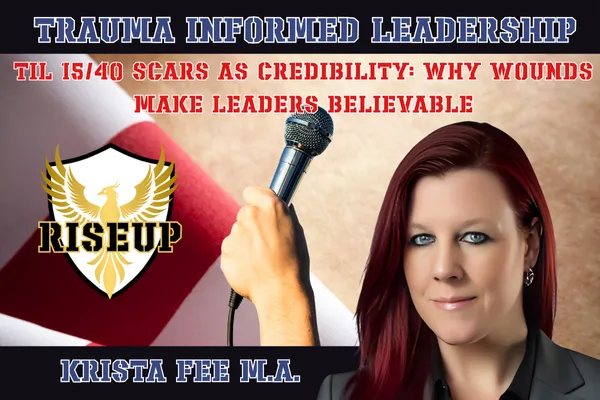
Scars As Credibility: Why Wounds Make Leaders Believable
Scars as Credibility: Why Wounds Make Leaders Believable
How integrated pain becomes the most trusted form of authority in leadership
By Krista Fee, Founder of the RISEUP Phoenix Trauma and Crisis Institute
Leadership in today’s world often hides behind polished images, flawless résumés, and curated soundbites. But what people trust is not perfection—it’s proof. As someone who works at the intersection of trauma, resilience, and leadership, I’ve seen time and again that what makes leaders believable isn’t the absence of scars but the presence of them.
This blog expands on Episode 15 of the RISEUP Voices From the Frontlines podcast, where I share how scars can become a leader’s most credible testimony.
Scars Tell Stories
We live in a culture obsessed with image. Leaders are told to appear flawless, maintain composure, and never reveal cracks. But credibility isn’t forged in ease; it’s forged in fire.
Followers admire talent, eloquence, or vision. But they trust evidence that a leader has suffered and survived. Scars, carried with honesty, are proof of passage. They say: I’ve been through the fire, and I am still here.
In trauma-informed leadership, scars aren’t liabilities to conceal but wisdom to be shared.
History’s Witnesses: Lewis and Mandela
John Lewis bore scars from Bloody Sunday on the Edmund Pettus Bridge. His credibility didn’t rest solely on speeches or strategy. It was embodied in his wounds. When he spoke of justice, people leaned in because they knew he had paid for every word.
Nelson Mandela, too, emerged from 27 years in prison scarred but morally stronger. His wounds gave him authority no polished argument ever could. These leaders remind us that scars are not disqualifications—they are the very substance of leadership credibility.
A Modern Scar: The Assassination of Charlie Kirk
Sometimes the scar isn’t on the leader’s body but in their absence. Charlie Kirk’s assassination shocked communities across the nation. Yet in that violent wound, something extraordinary happened.
Vigils filled cities. Hundreds of thousands gathered. Millions tuned in online. What people described wasn’t just grief—it was awakening. Many called it a revival.
The scar of Kirk’s death became the very thing that magnified his leadership. His absence sparked unprecedented unity, showing that sometimes the cost of sacrifice transforms a leader’s voice into a movement that outlives them.
The Trap of Hiding Scars
Leaders often try to hide their scars. They fear vulnerability looks like weakness. But invulnerability doesn’t inspire, it intimidates. Worse, hidden scars remain unhealed. Leaders who deny their wounds often end up leading from reactivity rather than wisdom. Conflict feels like betrayal. Feedback feels like humiliation. Their organizations absorb the chaos of their unresolved pain.
Neuroscience of Unintegrated Wounds
Neuroscience shows trauma dysregulates the limbic system, narrowing attention to threat and amplifying emotional reactivity. Leaders with unprocessed trauma often misinterpret challenges: dissent as disloyalty, mistakes as sabotage.
The fallout is predictable:
Fear spreads
Innovation shrinks
Loyalty is demanded, not inspired
This is why trauma-informed leadership matters. Without integration, wounds become systems of harm.
When Scars Become Systems
I once worked with a CEO betrayed by a former partner. He hardened around the wound, suspecting every new hire, punishing small mistakes harshly. His personal scar metastasized into an organizational culture of suspicion. Talent left, not because of the mission, but because fear had become the air.
Scars hidden become systems distorted.
Integrated Wounds Create Empathy
But scars don’t have to consume. Integrated wounds transform into empathy. Psychologists call this survivor’s empathy. Neuroscience supports this: lived pain enhances our ability to recognize suffering in others.
Leaders who have been betrayed often develop more effective systems of trust. Leaders who’ve endured injustice are quick to spot inequity. Leaders who’ve known grief often bring compassion into places where efficiency once dominated.
A Nurse and the Scar in Her Voice
I met a nurse who lost her husband suddenly. For months, she struggled to return to work. When she did, she said, “I don’t have to say much anymore. Patients just know I understand.”
Her scar wasn’t visible, but it shaped her presence. Patients trusted her not just as a professional, but as someone who had walked through pain and refused to flinch in the face of theirs.
Scars, when integrated, give leaders the ability to hold suffering without collapsing under it.
Learning Without Anchoring in the Past
Scars must illuminate, not anchor. Leaders who define themselves only by their wounds become trapped in the past. Healing requires both acknowledgment and release. The phoenix does not stay in the ashes; it knows it must RISEUP into something new.
Scars should say: This is where I’ve been, not This is all I am.
My Scars, My Witness
I carry scars of my own—as the throwaway daughter of a victim of human trafficking, a survivor of childhood sexual abuse, and a survivor of domestic violence. For years, I thought leadership meant hiding those truths. However, I’ve learned that my scars are a testament to my credibility.
They allow me to say with honesty: I know what brokenness feels like—and I also know healing is possible.
Practical Anchors: Turning Scars Into Credibility
Name the wound. Say what happened without shame.
Seek integration, not erasure. Scars aren’t meant to vanish; they’re meant to witness.
Practice survivor’s empathy. Let scars open your capacity to sit with pain.
Check for reactivity. Ask: Am I leading from wisdom or from my wound?
Narrate scars as a journey. Share stories that point to growth, not grievance.
Final Reflection
The leaders we trust most aren’t the flawless ones. They’re the scarred ones, the ones who can look us in the eye and say, I’ve been through it too, and I’m still standing.
Your scars are not your shame. They are your witness. When integrated, they are the most credible testimony you will ever carry.
Call to Action
🔥 Ready to learn how to transform scars into systems of trust and resilience?
👉Book a call with me to explore how Trauma-Informed Leadership training can support your team.
And don’t miss the Trauma-Informed Leadership Course and Community, where you’ll find practical tools, neuroscience-backed strategies, and a network of leaders committed to rising stronger.


